Followers

Tuesday, April 27, 2010

THE ANGEL'S GAME by Carlos Ruiz Zafon - Review by Gary Carden


The Angel’s Game by Carlos Ruiz Zafon
New York: Doubleday Publishers - 2009
$26.95 - 470 pages

“Do you want to set fire to the whole world and burn with it?
Let’s do it together. You fix the price.”
- Andreas Corelli, p.128

A few days after completing The Shadow of the Wind, I discovered a copy of Carlos Zafon’s new novel, The Angel’s Game. When I sampled a few pages to see if it had the same extraordinary imagery and cadence of its predecessor, I found that its setting was the same: Barcelona in the 20’s, a visit to the “Cemetery of Forgotten Books,” treks through fog-shrouded graveyards, and the wonderful Sempere Bookstore, the place where star-crossed love, madness and murder converge.

However, The Angel's Game is not a sequel. Daniel Sempere, the protagonist in The Shadow of the Wind is regulated to the role of a minor character in this tale of unholy alliances, paranoia and obsession. It is as though while Daniel Sempere’s anguished tale of love and redemption was unfolding, another doomed protagonist, David Martin (who just happens to lives nearby) is also beginning his own dark journey through “the city of the damned.” Although the two men are friends, they have very little in common ... except a love of books.

Zafon, a master of provocative beginnings, lets David tell his own story which begins with a badly beaten child who enters the Sempere Bookstore clutching a blood-stained copy of Charles Dickens’ Great Expectations. The child (David Martin) begs Sempere Senior to keep the book safe since Martin’s abusive father intends to destroy it. Sempere not only hides the book; he also becomes David’s protector and advisor, assisting the boy in achieving his wish to become a writer.

In time David Martin becomes a journalist and a successful writer of a series of blood-and-thunder pot-boilers, The City of the Damned. Although the books are extremely popular, David feels that they are cheap melodramas and dreams of writing a work that will win the respect of the literary world. David confides his dream to his friend, Pedro Vidal, a highly successful journalist, and in time, he begins work on his great opus, The Steps of Heaven.When he meets Christina, the daughter of Vidal’s chauffeur, David feels that he has an established career. He decides to terminate his contract with the shady publishing firm that distributes The City of the Damned and devote himself to his new friends and his writing. It is at this point that something goes terribly wrong with David’s life.

Within a few short weeks, David discovers the following: he is entangled in a lawsuit with his former publishers, Barrido and Escobillas; he learns that Christina is involved with his best friend, Pedro Vidal and when his new novel is published, the critics judge it to be a hopeless, amateurish work. At the same time, Vidal publishes a novel (written by David) and it is declared a literary masterpiece. Finally, when recurring headaches and nausea forces David to consult a doctor, he is told that he has a brain tumor which will kill him in a few months.

When David Martin is at his lowest point, he meets Andreas Corelli, a mysterious publisher “of religious texts,” who offers to solve all of David’s problems if he will agree to write a book in accordance to Corelli’s dictates. Martin agrees and suddenly, miraculously, the deadly tumor is gone. Corelli gives David 100,000 francs “as a starter.” Shortly afterwards, David learns that the lives of Barrido and Escobillas have been snuffed out in a mysterious fire which had also destroyed all documents and contracts. David moves into an abandoned but luxurious mansion in the heart of Barcelona... a house that he has always coveted, and begins work on Corelli’s book.

Obviously, David Martin has made a Faustian bargain, and although there is much is Corelli’s demeanor to suggest the demonic (he appears to be ageless and his eyes are reptilian), the division between Good and Evil wavers and changes frequently. In time, Martin discovers that he is only the latest of Corelli’s “authors for hire,” and that each of his predecessors has died tragically - In fact, one of them lived in the same house that Martin now occupies. Nor are the authors the only victims. All that they love, including wives, lovers and children are doomed.

But what about the book? What is the subject? The strange mythical tale that David creates is a kind of religious fable; the kind of “folk tale” that can serve as the basis for a religious belief that has the power to capture the imagination of millions. As David writes, he often appears to be a conduit, a mere instrument for verbalizing a fiendish tale that is being dictated by Andreas Corelli. At other times, Zafon suggests that perhaps Corelli exists only as projection of David Martin’s own corrupt soul. Regardless, David senses that the book he is writing may have the power to plunge the world into an apocalyptic war.

Regardless of who is responsible, someone is definitely creating havoc in David Martin’s world. The Angel's Game is filled with hapless victims who are driven mad or die in random accidents. In addition, as the action of this novel accelerates, the narrative is littered with corpses: murdered policemen, mutilated lawyers, drowned paraplegics and lovers. As this Grand Guignol of a novel winds down, the reader is left with a singular suspicion. Is it possible that David Martin and Andreas Corelli are one and the same? If not, is it possible that the protagonist is “becoming” Corelli?

Without a doubt, The Angel's Game contains one of the most remarkable “poetic chapters” that I have encountered in recent literature. This one deals with the death of Sempere Senior, the bookstore owner who is a major character in both The Shadow of the Wind and The Angel's Game. As Sempere’s friends gather(mostly patrons of his bookstore), the funeral service turns into a kind of eulogy for all book lovers... those people who avoid churches and religious cant, but treat books with the kind of respect and awe that is normally expended in churches. Sempere is buried with David’s copy of Great Expectations beneath his clasped hands.

Although I liked this book tremendously, I was occasionally distressed by melodramatic passages characterized by a kind of hysterical rant that appears at odds with Zafon’s usually superb style. David Martin frequently shreds the scenery like a ham actor, posturing and proclaiming cliches. I was especially distressed by his constant use of the words “venomous” and “poisonous,” and the tremendous number of unpleasant waiters, desk clerks, and government officials that populate Barcelona. Given the remarkable quality of Zefon’s writing in The Shadow of the Wind, I can only conclude that the patches of bad writing in The Angel's Game is the result of a bad translation. I learned recently that The Angel's Game will be reissued with a new translation this year. I sincerely hope that is true.

Tuesday, April 20, 2010

MARK TWAIN, THE MOUNTAIN AND ME


This guy that I am seriously attempting to embarrass is one of my best friends, Marvin Cole. If you haven't noticed, Marvin bears a marked resemblace to Mark Twain ... So much so that Marvin has been portraying Twain for a considerable part of his life. For many years, Marvin and I taught elderhostels together at the Mountain Retreat on Scaly Mountain near Highlands. We were frequently joined by Shelia Kay Adams and we developed a popular presentation that was a kind of mixed bag of storytelling and music called "A Season of Laughter." Recently, we were invited to the Mountain Retreat for a "Recognition Lunch" at which we were fed, praised and given tokens of appreciation (a paperweight, a Mountain Retreat cap, a coffee cup and a large photo of ourselves. Shelia Kay didn't show up so Marvin and I were left to recall the highlights of our elderhostel programs (I was there for 35 years). Regardless of what I may have felt about the Recognition Ceremony, I was pleased to see Marvin who is one of the most genial and kind people that I have ever met. He is still out there somewhere in an ice cream suit, smoking a big cigar and posing as Mark Twain to standing ovations. If you haven't seen him, you should Google him.

Monday, April 19, 2010

A WORDLE FROM REBEL FAN

Wordle: Gary Carden's interview with the Smoky Mountain News Have any of you seen a "Wordle"? This one was sent to me by Rebel Fan.
The image is created by taking something that you have written and submitting it to the "Wordle.net/" site where they will convert it into an image like this. Rebel Fan created this one by submitting my interview in Smoky Mountain News to the Wordle process. The above is the result.
Go ahead and try it! If you click on this one, you will find all the information you need to get your own.

Sunday, April 18, 2010

The Stecoah Fine Arts Center

I found this spiffy cat hanging on the wall in the Stecoah Cultural Arts Center and couldn't resist. The Center is full of original art.

Friday, April 16, 2010

CHANUCEY SAYS SPRING IS HERE....ALMOST


I've had a lot of inquiries lately about Chauncey, the rooster that I bought last fall. People want to know if he is still strutting in my chicken lot. Yes,he is. However, his "Spring is here!" crowing has attracted the attention of my resident fox who came down and looked at him this morning. Chauncey got very quiet and Jack, my fat jack russell, ran the fox off. (The fox didn't hurry since Jack is fat and slow.) As soon as the fox was out of sight, Chauncey once more informed the world that it is spring....almost

Wednesday, April 14, 2010

THE SHADOW OF THE WIND by Carlos Ruiz Zafon - reviewed by Gary Carden


The Shadow of the Wind by Carlos Ruiz Zafon
New York: Penguin Books
$25.00 - 487 pages

“As far as I can see, it (cinema) is only a way of feeding the mindless
and making them even more stupid. Worse than football or bullfights.
The cinema began as an invention for entertaining the illiterate masses.
Fifty years on, it is much the same.”

Fermin Ramero De Torres - The Shadow of the Wind, p. 89

Let’s begin with a marvelous story - one of those timeless fables that is charged with mystery and magic - the kind that provides the basis for great novels. Somewhere on a dark and lonely street in Barcelona, there is an ancient, locked building called the Cemetery of Forgotten Books. If you know the password, or if you have a friend who is willing to take you as his “guest,” you may gain entrance and wander through a labyrinth of echoing corridors of abandoned books until you become lost like the legendary Theseus. When you are finally rescued (if you are!), then you will be allowed to select a single volume with the understanding that you will return it some day - perhaps, after it has altered your life in significant ways. When Daniel Sempere, the protagonist of The Shadow of the Wind, comes to the Cemetery of Forgotten Books with his father, the ten-year-old boy takes a book entitled ... The Shadow of the Wind.

So begins an incredible journey that carries Daniel through a strange city filled with abandoned mansions, exotic cafes, fantastic bookstores, spirit-haunted graveyards and sinister prisons from which no inmate ever returns. Zafon’s novel is populated with a cast of characters that resemble the tortured, guilt-ridden lovers of Gabriel Garcia Marquez, the obsessed killers of Jorge Luis Borges and the doomed and solitary eccentrics of Charles Dickens. The Shadow of the Wind is an epic tale that alternately reads like Dante’s nightmarish descent into the underworld and Candide’s trek through a venal, corrupt and cruel world. In short, this is a hell of a book!

Daniel’s most memorable encounters include an infatuation with Clara Barcelo, a beautiful blind girl who plays the piano ineptly (her rendition of Mozart sounds like a macaw randomly pecking piano keys); Don Federico, a watchmaker with a penchant for dressing like female opera stars; Javier Francisco Fumero,a deranged policeman, who in addition to murdering his own mother, has devoted his life to tracking down Julian Carax, the author of The Shadow of the Wind - a mission that amounts to a terrifying obsession (much like another “relentless policeman,” Javert in Les Miserables). Lain Courbert, a ghostly figure with a leather mask that hides a face burned beyond recognition, proves to be another deranged creature. Courbert has devoted his life to finding ... and burning every existing copy of The Shadow of the Wind. (Is it possible that he might really be the Julian Corax? If so, why?)In addition, there are multitudes of minor characters, including “La Pepita,” an elderly matron with a gift for pistol-shot flatulence that is rumored to be so deadly, it stuns sparrows on her balcony and sends them plummeting, senseless, to the pavement below; a horny, dying octogenarian who bargains with Daniel for one last lusty encounter, and a host of saintly nuns who devote their lives to protecting Zafon’s most foolish and/or helpless characters, including Bea Aguiler, the love of Daniel’s life.

The most remarkable character in the book, Fermin Romero de Torres, embodies the traits of both Cyrano de Bergerac (romantic and linguistic excesses), and Don Quixote ( the man with the “impossible dream”). Saved from poverty and almost certain death by Daniel Sempere, Fermin becomes Daniel’s protector, advisor and confidante. In addition, much of The Shadow of the Wind’s wit and charm is the result of Fermin’s outrageous pronouncements on art, human frailty and sex. Fermin’s enthusiasm for American movies and stars such as Cary Grant, Veronica Lake and Carol Lombard, prompts him to mimic the “noir” movies that he adores. Each time that he appears, he assumes a different guise: detective, priest, lover, etc. In fact, the irrepressible Fermin sometimes comes dangerously close to dominating this novel!

Beneath the novel’s colorful facade is a touching story of Daniel’s relationship with his father, the proprietor of a highly respected bookstore that is barely surviving in a world where readers are decreasing at an alarming rate. When Daniel finds a copy of The Shadow of the Wind, he becomes fascinated by the book’s mysterious author, Julian Carax. Daniel begins a search to find Carax only to make the disquieting discovery that the author’s life bears an eerie resemblance to his own. In addition, as he meets Carax’s former lovers, enemies and acquaintances, he also encounters not only a marked resistance to his search, but a growing hostility. Time and time again, he is told to abandon his search or he may uncover a truth that he cannot bear.

An increasing amount of evidence indicates that Carax is dead but Daniel comes to believe that the author has achieved a kind of immortality in his novels. When the warehouse in which the remaindered copies of The Shadow of the Wind are stored mysteriously burns, Daniel suspects that someone is determined to extinguish this last vestige of Corax’s memory. Is it possible that Corax is not truly dead as long as a copies of his novels exist? Could it be that Lain Courbert, the man who has devoted his life to burning all of Corax’s novels, believes that he is carrying out a kind of “cleansing”? What is the basis for Javert Francisco Fumero’s hatred of Corax? Why is that hatred eventually transferred to Daniel Sempere?

Before all of these questions are answered Daniel will learn the truth about Corax’s love with a young woman named Penelope Aldaya and when The Shadow of the Wind begins a descent into madness, vengeance and murder, all of the disparate pieces of this epic (and highly sensual) novel converge into a thundering, blood-drenched denouement. This is a marvelous book that will provide fodder for your fantasies for months to come.

Monday, April 12, 2010

CHRIS WILCOX, MY FAVORITE BOOK STORE MANAGER

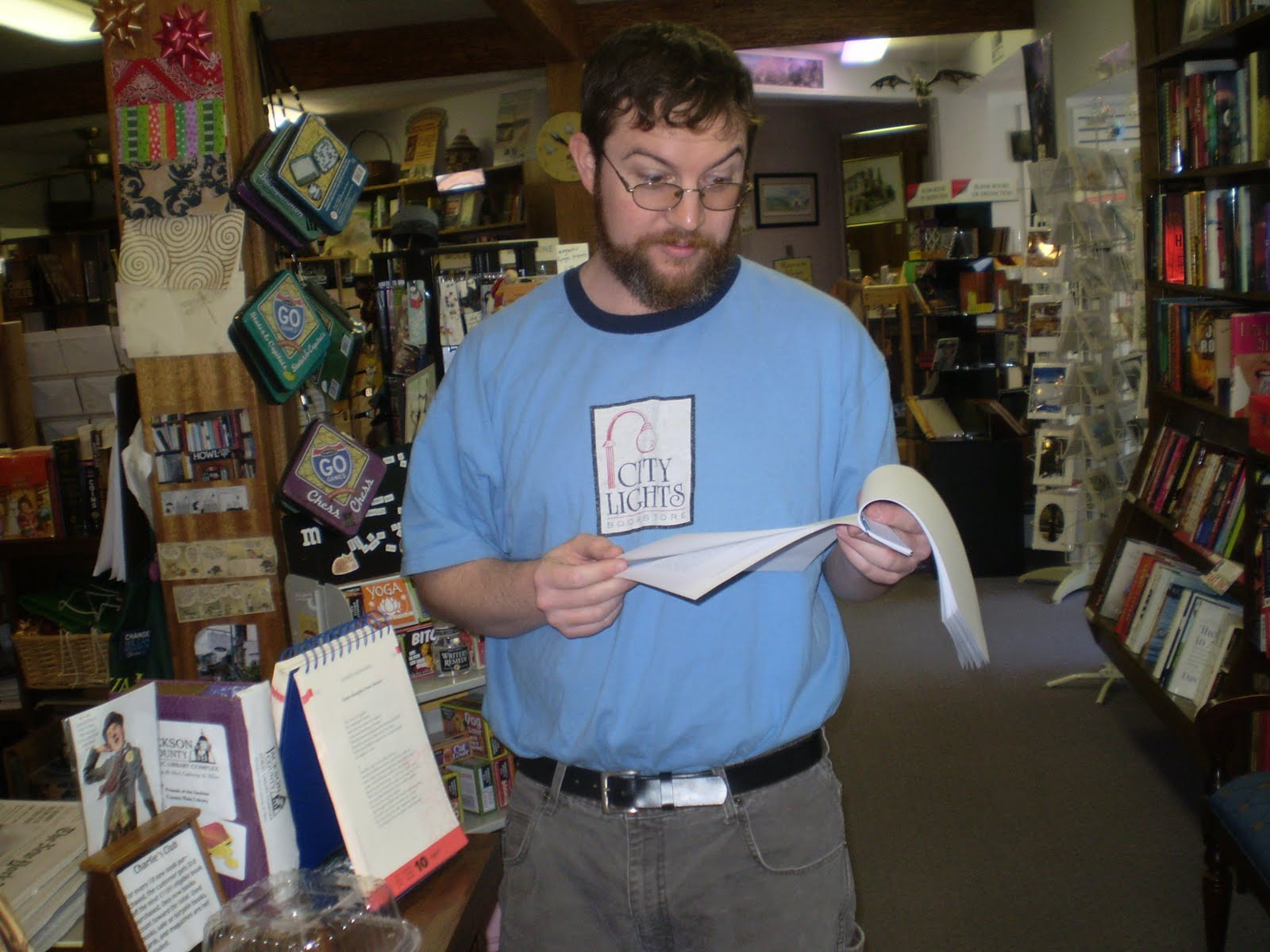
The guy who looks a trifle alarmed is Chris Wilcox, the manager of City Lights Bookstore. He is reading my latest
dramatic monologue, "Signs and Wonders," which is slated for production in California in June.

LESSIE BELTS IT OUT AT CITY LIGHTS!


Last Saturday (April 10th at 4:00)
Lessie Williams, the "Godmother of Gospel"held forth at the City Lights Bookstore for an enthralled audience of local fans. She was assisted by her son who is a music major at Mars Hill, and in short order, she had hands clapping and toes tapping. Every time I hear her, I think that I need to write a one-woman show about Harriet Tubman and give Lessie the part of Harriet.

Sunday, April 4, 2010

CHAUCER'S CANTERBURY TALES RETOLD BY PETER ACKROYD...REVIEWED BY GARY CARDEN


Geoffrey Chaucer’s The Canterbury Tales: a Retelling by Peter Ackroyd
New York: Viking Press
$35.00 - 436 pages


Whan that Aprille with his showres soote
The droughte of March hath perced to the roote,
And bathed every veine in swich licour,
Of which vertu engendred is the flowr;
Whan Zephyrus eek with his sweete breeth
Inspired hath in every holt and heeth
The tender croppes, and the younge sonne
Hath in the Ram his halve cours yronne,
And smale fowles maken melodye
That slepen all the night with open ye -
So priketh him Nature in hir corages -
Thanne longen folk to goon on pilgrimages,


Being an old English teacher, I am aware of a literary tradition regarding classical works of literature: every generation of so, “masterpieces,”such asThe Iliad, The Odyssey, the plays of Sophocles and Euripides and ancient epics such as Gilgamesh and The Decameron are translated (again) by a new group of prominent scholars. The purpose of these translations, according to the translators, is to make the classics more “relevant” to modern readers. For example, a careful translation of “Antigone” may reveal subtle similarities between King Creon’s military policy and Germany’s Third Reich. Recently, a new “interpretation” of Gilgamesh uncovered marked similarities between the fate of an arrogant tyrant 3,000 years ago and the invasion of Iraq during George Bush’s presidency. No doubt, similar reasons were given for a new translation of the Greek Bacchae during the height of San Francisco’s “hippie movement” when Timothy Leary’s fans ran amuck.

However, this time out, we have a modern translation of Chaucer’s Canterbury Tales by Peter Ackroyd - a translation designed to make this venerable 14th century literary work relevant to “the audience of today.” Ackroyd tells us Chaucer’s poetic (but archaic) language has rendered this marvelous collection of stories obscure and/or meaningless to the modern reader. Why not “translate” the entire work into conventional modern language? To illustrate his point, Ackroyd “retells” the passage that introduces this review (“The Prologue”) as follows:

“When the soft, sweet showers of April reach the roots of all things, refreshing the parched earth, nourishing every saplings and every seedling, then humankind rises up in joy and expectations. The west wind blows away the stench of the city and crops flourish in the fields beyond the walls. After the waste of winter, it is delightful to hear birdsong once more in the streets. The trees themselves are bathed in song. It is a time of general renewal and restoration. The sun has passed midway through the sign of the Ram, a good time for the sinews and the heart. This is the best season of the year for travelers. That is why good folk then long to go on pilgrimages."


Now, admittedly, Ackroyd’s passage is much easier to read since he has removed all of the archaic words and spelling. However, he has also removed Chaucer’s poetry (his meter and rimes) which has been replaced by... conventional prose. Is it better?

When I encountered The Canterbury Tales in my sophomore year at WCU (with my Cliff Notes firmly in hand), I discovered that there were 28 pilgrims who intended to make a leisurely journey from London to Canterbury to the tomb of Thomas a’Becket, and that Chaucer originally intended for each of them to tell four stories - two going and two coming back - a total of 112 tales. In actual fact, Chaucer only completed 24 tales. However, it is am amazingly varied collection which ranges from bawdy fabliaux (dirty joke) to anti-Semitic rants and high-minded moral sermons.

Despite the fact that it has been over fifty years since I read Chaucer for the first time, it is amazing how vividly many of these characters live in my memory. Both the gap-toothed Wife of Bath, with her obsession with sex and the sleazy Pardoner with his jar of “pig bones” (which he sells as holy relics along with his “papal indulgences”) are morally corrupt - yet Chaucer’s descriptions of them give them a kind of literary immortality. In addition, despite the repulsive nature of speaker, “The Pardoner’s Tale” remains one of the great cautionary tales of literature.

Ackroyd’s “retelling” of such ribald classics as “The Miller’s Tale.” “The Reeve’s Tale” and “The Summoner’s Tale” are probably the original prototypes, of the 20th century “traveling salesmen” jokes since they all deal with cuckoldry, sexual misadventures and flatulence, and all are examples of low comedy. Ackroyd retells all of Chaucer’s “dirty jokes” with a sort gleeful zest that definitely adds to their humor. For example, the college students in both “The Summoner’s Tale” and the “The Miller’s Tale” speak in modern-day “cockney” and use many of the current, four-letter, sexual idioms. This is equally true of the Nun’s Priest’s tale which gives an earthy account of the barnyard adventures of Chanticleer, the lusty rooster!

Many of the stories are boring (“The Knight’s Tale”), pretentious and/or ridiculous (“The Clerk’s Tale” of the “patient Griselda”), or moral tales filled with religious hypocrisy and anti-Semitism (“The Prioress’ Tale” of how Little Saint Hugh was slain by the Jews and “The Second Nun’s Tale” of Saint Cecilia’s martyrdom). Ironically, Chaucer is not responsible for the literary shortcomings of the tales, for each stands as an insight into the personality of the speaker. For example, Chaucer’s Knight is noble, honest and poor, but he is unable to tell an interesting story. One can imagine the pilgrims nodding off in the saddle as the poor Knight drones on and on. It is interesting that the most morally offensive tales are told by religious personages such as the Nun, the Prioress and the Clerk - all of which unwittingly reveal their own ethical shortcomings.

It well may be that Ackroyd’s retelling of Chaucer’s Canterbury Talesia may actually create a revival of interest in this 14th century classic. The low humor is still hilarious and Chaucer has a marvelous talent for revealing the pompous self-importance of corrupt 14th century church officials. It is especially important to remember that the opinions expressed by Chaucer’s pilgrims are not Chaucer’s - especially with stories like “The Clerk’s Tale” which is easily the yarn most likely to infuriate a modern feminist. I believe that Chaucer would share her outrage.