Followers

Showing posts with label serial killers. Show all posts

Friday, May 27, 2011

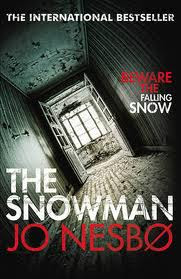
SNOWMAN by Jo Nesbo Reviewed by Gary Carden

Snowman by Joe Nesbo
New York: Alfred A. Knopf
$25.95 - 384 pages

Soon the first snow will come. And then he will appear again. The snowman. And when the snow has gone, he will have taken someone else. What you should ask yourself is this: “Who made the snowman? Who makes snowmen? Who gave birth to the Murri?” For the snowman doesn’t know.
Snowman, p. 60-61

Jo Nesbo’s protagonist, Inspector Harry Hole, is a daunting piece of work. A chain-smoking manic depressive and an alcoholic, Harry’s job security is tenuous. In fact, several administrators, are eager to fire the hulking, short-tempered Hole. Refusing to observe office hours and openly displaying contempt for his “superiors,” Harry’s presence rankles everyone, including most of the women in his life. The only factor in his favor is the fact that he has repeatedly demonstrated that he is the department’s most efficient employee. Time and time again, he identifies and pursues murderers like some mythical fury, following culprits into other countries (Australia, South America, etc.). As a result, Harry Hole has become something of a legend (and a pariah) in the Oslo police department.

This time out, Harry is matching wits with a serial killer who marks murder sites with a snowman. His victims - usually women, but with one notable exception - are dispatched in a Grand Guignol style that litters the landscape with body parts that are sometimes “rearranged” and/or reconstructed (in a manner similar to the victims of serial killers on the American TV show, “Dexter”.) Inspector Hole suspects that there is a common theme that ties all of the murders together. When he begins to delve into the private lives of the victims, he discovers a disturbing common feature: Infidelity. In addition, DNA testing reveals that all had given birth to children who had been “fathered” by someone other than the victim’s husband. Repeatedly, the Snowman sends a message to each proposed victim: “You are going to die because you are a whore.”

Eventually, Harry discovers that the murder victims have been marked by something much more serious than mere infidelity. Since statistical data indicates that 20% of Norway’s children owe their existence to men other than those identified as their “legal fathers,” Hole searches for, and finds a more disturbing factor. In spite of numerous false leads, he finally learns of a mysterious medical center called the Marienlyst Clinic where patients are treated for an obscure hereditary disease called Fahr’s Syndrome. Infected genes, passed form a “carrier male” are dormant for a time, but eventually, they spread through their hapless victims, destroying their motor skills by a kind of calcification that renders the bones and facial features misshapen and grotesque.

Suddenly, Harry is faced with a disquieting possibility. Is it possible that the Snowman is a victim of Fahr’s Syndrome? Is he systematically eliminating all of the women who have become unwitting carriers of the disease? When DNA proves that all of the infected victims were fathered by the same (unknown) male, Harry begins to speculate. Does this “carrier” heedlessly pass the infection on to numerous unsuspecting victims or does he know what he is doing?

Snowman is populated by the usual inept, foolish and arrogant members of the Oslo Police Department; however, Harry is destined to encounter an impressive number of “unusual” characters ranging from the vain and egotistical to the obsessed, psychotic and paranoid. Among the most interesting are: Arve Stop, the editor of a controversial magazine appropriately called “Liberal.” Arve is also a popular talk show guest and celebrity who, according to rumors, has a compulsion to seduce every attractive woman that crosses his path (sometimes several in a single day). Stop often selects his “overnight guests” from studio audiences and parties. Then, there is Idar Vetlesen, a gifted plastic surgeon who has “redesigned” the features of some of Norway’s most famous citizens. In addition to his profitable surgery, Idar frequents a local hotel that is a hang-out for prostitutes and sexually abused children. (Adar also claims to be an authority on Fahr’s Syndrome). Another provocative member of the medical profession is Mathis Lund-Helgesen. As a child, he was called “Mathis No Nips” due to the fact that he was born without nipples. As luck would have it, Mathis intends to marry Rakel Fauke, Harry’s old flame. (Yes, Rakel has finally had enough of Harry’s drinking and brooding.) Finally, there is Katrine Bratt, recently of the Bergen Crime Squad who has been reassigned to Harry Hole’s department. Harry soon discovers that Katrine is both capable and unstable. There is something dark and sinister in her past and Harry suspects that Katrine has “her own agenda.”

At some point in Snowman, each of these four characters (Stop, Vetiesen, Mathis and Kathrine) are suspects (Yes, one of them is the Snowman). Part of the mystery surrounding the serial killer’s identity involves the disappearance of a corrupt, disgraced Bergen policeman, Gert “Iron” Rafto. In fact, Rafto’s reputation for brutality had made him a suspect in the Snowman murders - a solution that was abandoned when Rafto disappeared and the murders continued. When Rafto’s body is finally discovered (the only male Snowman victim) Harry blundered on a disquieting theory. If Harry is Oslo’s most capable policeman ... and if Rafto was Burgen’s most efficient investigator .... could this mean that the Snowman knows that he will never be caught if he can simply eliminate investigators who have the reputation of being “the best”?

Snowman contains the usual Jo Nesbo signatures: tension and horror wrapped in a marvelous collection of arcane facts. For example, Harry ponders the fact that the female Berhaus seal will not mate with the same male twice - a dilemma that prompts the male to kill her rather than give her up. The reader also learns that Harry is a devoted follower of American culture and often delivers passionate diatribes on American politics (he is critical of the Bush administration), pop music (Harry collects Joni Mitchell, Bob Marley (and Bruce Springsteen) and American film (Harry things that “Starship Troopers” is a satirical attack on American culture.

However, despite the fact that Snowman is one of Nesbo’s best “thrillers,” a kind of anxiety dominates the action. Although Harry Hole remains a dark paranoid anti-hero, he seems to be suffering from an number of ailments. Everyone comments on his “loss of weight,” and Harry now has the added inconvenience of having his apartment contaminated with mold. In spite of his insomnia, Harry soldiers on, armed only with a carton of cigarettes and a stock of Jim Beam. Certainly, by the time he emerges from the riveting conclusion of Snowman, he is battered and exhausted. Hopefully, it will take more than a mold infection and the loss of a finger or two to send him out to pasture.

Friday, March 11, 2011

FULL DARK, NO STARS by Stephen King - reviewed by Gary Carden


Full Dark, No Stars by Stephen King
New York: Scribners
$27.99 - 368 pages


“I have no quarrel with literary fiction which usually concerns itself with
extraordinary people in ordinary situations, but as a reader and a writer,
I’m much more interested in ordinary people in extraordinary situations.”

- Stephen King

At the conclusion of this collection of four novellas: Full Dark, No Stars, Stephen King adds an “Afterword.” In acknowledging that his quartet of stories is “a bit harsh,” King goes on to make some provocative observations on both the reasons for his success as a writer and his beliefs about the significance and /or purpose of fiction. Essentially, King feels that writing is the act of taking meaningless and/or random events and arranging them in a pattern that gives the lives of his characters the appearance of an order and meaning. The implication is that this “appearance of logical order” is artifice, or fabrication.

What is especially interesting about King’s comments is the fact that he acknowledges a debt to the American writer Frank Norris. Anyone who is familiar with Norris will immediately recall McTeague, the author’s “naturalistic novel” that recounts a grim tale about a man who is a hapless pawn to forces beyond his control. The popular literary term that describes McTeague’s dilemma is “determinism,” and embodies factors such as heredity, environment ... and chance. With this in mind, King’s four tales acquire an additional “noir” quality.

“1922” grew out of King’s fascination with Michael Lesy’s Wisconsin Death Trip (which is well worth the trouble of tracking it down if you are not familiar with it). A bizarre collection of photographs and news articles, Lesy’s book presents a disturbing “vision” of the harsh life of farm families in the Midwest during the depression. King chooses to depict such a family and gives a vivid account of the forces that move them. Wilfred James, the protagonist of “1922,” confesses the details of his wife’s death (a gruesome murder that was never discovered) and its consequences.The fact that Wilfred’s teenage son, Henry, becomes an unwilling accomplice to the crime complicates matters considerably. In fact, poor Henry’s guilt provides the corroding poison that blights the lives of a dozen innocent people. The crime is motivated by land (Wilfred’s wife wants to sell it and move to the city and Henry is determined to keep it). When King adds a few mitigating circumstances, such as a mortgage, a ruthless banker, Henry’s pregnant girlfriend, and Wilfred’s phobia about rats, “1922” acquires sufficient deterministic forces to assure a tragic denouement. In addition, the plot includes a colorful “Bonnie and Clyde” couple (Henry and his pregnant girlfriend) who are also created (and destroyed) by forces beyond their control.

In “Big Driver,” King presents one of his most appealing characters: Tess, a gentle soul who has managed to find her niche in the literary world by developing a series of mysteries, each of which features a witty collection of ladies who solve murders while they knit (“The Willow Grove Knitting Society.”) Tess is blessed by a modest “cult following” and when she isn’t busy working on her next mystery, she augments her income (and savings) with speaking engagements. Her cozy and quiet life style contains only two companions: Fritzy, her cat and Tom-Tom, her GPS (the latest in satellite navigation systems that enables Tess to find her way to her speaking engagements).

When Tess takes an ill-advised short-cut home from a speaking engagement, she ends up in a cleverly-devised trap on a remote road where she is raped, brutally violated and left for dead ... stuffed in a drainage pipe with several corpses. Unwilling to report the crime (she knows what happens to rape victims in the media) and mindful of the fact that her rapist will continue to maim and murder, Tess is plagued with guilt and anger. So begins a fascinating study of an ordinary (moral and law-abiding) woman who is forced by circumstances to become an agent for justice and, yes...revenge. Utilizing her skills as a researcher, she not only succeeds in identifying her rapist, but discovers a surprising link between her last speaking engagement where her “helpful employer” gave her the information about the ill-advised shortcut home. The tension builds when Tess loads her .38, feeds Fritzy, programs her GPS and drives away into the dark...

“Fair Extension” is King’s darkly humorous version of the old Faustian bargain with the Devil. Dave Streeter, a nice fellow who has terminal cancer, finds pudgy Mr. Elvid sitting under a yellow umbrella on a side street near the airport. Mr. Elvid seems to be a street vender and has a sign on his table that says “Fair Price.” However, he has no visible wares to sell. When Dave realizes who the vender is and makes a cautious inquiry, Elvid assures him that instead of his soul (souls no longer have any value), Mr. Elvid wants 15% of his annual income. Streeter agrees and is told that if all of Dave’s misfortunes are removed, he must “pass them on” to someone else. Dave selects his best friend, Tom Goodhugh. Dave goes home to find that not only is his cancer is in remission, his life is blessed with prosperity. During the next fifteen years, Dave’s fortunes thrive while Tom Goodhugh and all the members of his family ... once wealthy and powerful, descends into poverty, bad health. Does Dave Streeter suffer from guilt? Absolutely not. Instead, he dutifully forwards 15% of his annual income to Mr. Elvid’s account and basks in his good fortune....which continues unabated.

“A Good Marriage” owes its origin to King’s research into Dennis Rader, the infamous BTK serial killer. In his “Afterword,” King notes that Rader’s wife of 34 years never had the slightest suspicion of her husband’s “secret life.” However, following Rader’s confession, she endured considerable distress due to comments by neighbors and the media. In essence, these comments suggested that Rader’s wife “must have known something.” This response prompted King to write a story about a wife who inadvertently discovers that her husband has murdered at least eleven people during their 27-year-marriage. What would she do? In “A Good Marriage,” Darcy
Anderson has a strong sense of justice, but there are “extenuating circumstances.” If she calls the police, her life and the lives of her children will be wrecked. There must be a way to bring the monster down. There is.
This tale also has a satisfying conclusion that features Darcy’s meeting with a character that may remind some readers of Peter Falk’s popular character, Detective Columbo. Their dialogue is a masterpiece of evasion and implied meaning.

This is an excellent collection. King displays masterful control of his four dramas - all of which feature ordinary characters driven to extraordinary actions by circumstance. Frank Norris would be pleased.