Followers
Showing posts with label storytelling. Show all posts
Thursday, December 15, 2011
RICKMAN'S STORE, DECEMBER 9TH, 2011
Thursday, May 5, 2011
TALES FROM A FREE-RANGE CHILDHOOD by Donald Davis Review by Gary Carden
Tales from a Free-Range Childhood by Donald Davis
Winston-Salem: John F. Blair, Publisher
$19.95 (hardback) -242 pages
Storytellers draw inspiration from sources as varied as Shakespeare, the Brothers Grimm and the Bible; however the tales that immediately produce a resonating chord in most hearts are the ones that are drawn from a storyteller’s own life. If the “teller’s life” is blessed with a colorful assortment of relatives, a collection of childhood memories and a penchant for self-effacement, he/she possesses a winning combination. Donald Davis, like the bard of Lake Wobegon, Garrison Keillor, has that enviable gift. Not only can he recreate vivid images from his childhood (his favorite teachers, Valentine’s Day in the 4th grade, the first TV in the Davis home, etc.), he can prompt his listeners/readers to “recall” their own version of the same event.
As the title suggests, Tales from a Free-range Childhood, represents the first in a series of autobiographical tales dealing with Donald Davis’ early years in Haywood County. As Davis, one of this country’s most noted storytellers recalls his misadventures in kindergarden, his visits to his grandparents (who still had kerosene lamps) and his trips with his parents to church and local businesses, Davis conjures up a marvelous world filled with nostalgic landmarks: Charlie’s Drive-in, The Parkway Barbershop, Summerow’s Cash Grocery in Hazelwood, the bookmobile (a green panel truck) from the Haywood County Library, Massie’s Furniture, Whitman’s Bakery, etc.) Davis is blessed with total recall, even noting the difference between the taste of paste and glue in his class-constructed Valentine mail box. (Donald prefers the paste.)
The real magic in Tales from a Free-Range Childhood comes from Davis’ ability to construct a world of “eclectic nostalgia.” The author carefully selects vivid images that convey a sense of love, comfort, safety and stability. Davis and his little brother, Joe, grow up surrounded by doting relatives, delightful playmates, a few eccenric aunts and warm and caring teachers. If there were incidents of violence, child abuse or neglect in Haywood County during the first decade of the author’s life, he carefully erased them from this chronicle of a joyful, “adventurous” childhood.
What is left then? Essentially, it is Davis’ knack for finding a kind of drama (or moral precept) in the commonplace. For example, when five-year-old Donald is told to “watch the baby” (his two-year-old brother). Donald and another playmate create a game called “Make the Baby Cry,” which involved denying the baby (Joe) cookies and toys, attaching a suction-cup clown to Joe’s forehead and then covering Joe with Calamine lotion. When the mother returns and discovers Joe, she sort of “loses it.” It is a kind of “hissy-fit,” I guess. (Don has a talent for provoking this response from his mother.) She proclaims that “never will you be allowed to watch the baby again.” Exactly what Don wanted!
So begins an impressive catalog of “adventures” that go awry. There is an ill-advised haircut for baby Joe followed by an incident that makes Donald an unintentional shop-lifter at The Toggery (a woman’s clothing shop) in downtown Waynesville. Then, there is a delightful recounting of the educational debate, “to paddle or not to paddle” with a guest appearance by “Major Bowles,” one of Haywood County’s most beloved educators. Next, there is a trip to Grandma’s house complete with a night-time visit from the imaginary “ critters” that crawl up the wall and through bedroom window. This tale concludes with a familiar refrain: Don devises a prank to frighten his little brother who wets the bed; Don ends up sleeping in the bed.
Before a readers are half-way through this book, they are likely to conclude that the young Donald Davis was the type of kid that was constantly inventing adventures that had disastrous results... like the sled ride down a snow-covered slope into a tree. (Don had convinced the kids on the sled that if the were going fast enough, they would go right through the tree. “See the tracks in snow where I did it earlier? Here they are going into the tree and here they are on the other side of the tree!”)
There are stories about “cow pies” (Donald convinces Joe to jump in the middle of every cow pie the pasture); a trip to a carnival and a ride on “The Octopus” with memorable results, and a nostalgic tale about Donald’s first-grade teacher, Mrs. Ledbetter, and a Valentine Day project that was repeated in the following years. In the beginning, the students sent each other valentines and young Donald is intent in getting the largest number of anyone in his class. However, by the 4th grade, as Donald becomes increasingly aware of the little girl in the back of the room who rarely receives a valentine; eventually, he realizes there is a deeper meaning in exchanging valentines.
Donald Davis has published a great number of books about storytelling, including books on the history and techniques involved. Most of his admirers in this region are fully aware that Davis began as a minister. That fact has a great deal to do with the structure of a Don Davis story. Like a minister delivering a Sunday morning parable, he perceives his gentle and humorous tales as a means of illustrating life’s greatest gifts and joys: families that are bound together by affection, stability and mutual respect.
If storytellers develop “signatures,” and recognizable themes, One of Don
Davis’ recognizable components is self-effacement. His best stories involve the lovable trouble-maker who gets his comeuppance. Like the tricksters, Coyote, Brer Rabbit and Jack, he frequently devises a clever trap and then inadvertently falls into it himself. It is a type of humor that Appalachian storytellers learn to use as a shield - something between them and the world ... a world that cannot censor them since they have already confessed their flaws.
Tales from a Free-Range Childhood is a charming book, but, frankly I had much rather hear Don Davis tell a story than read it. Don’s greatest gifts are absent in this book: his facial expressions, his body language and,most of all, his marvelous sense of timing. Like many Davis fans, I have copies of “Barking at a Fox-Fur Coat,” and “the Crack of Dawn.” Thanks to the marvels of the internet, I often listen to Don on televised shows that originate from Orem, Utah and Ocracoke. If you prefer your storytellers “live,” be advised. Don Davis will be storyteller in residence at a number of locations in this area this summer, including “The Swag” near Maggie Valley.
Labels:
childhood,
nostalgia,
storytelling,
trickster tales
Monday, November 22, 2010
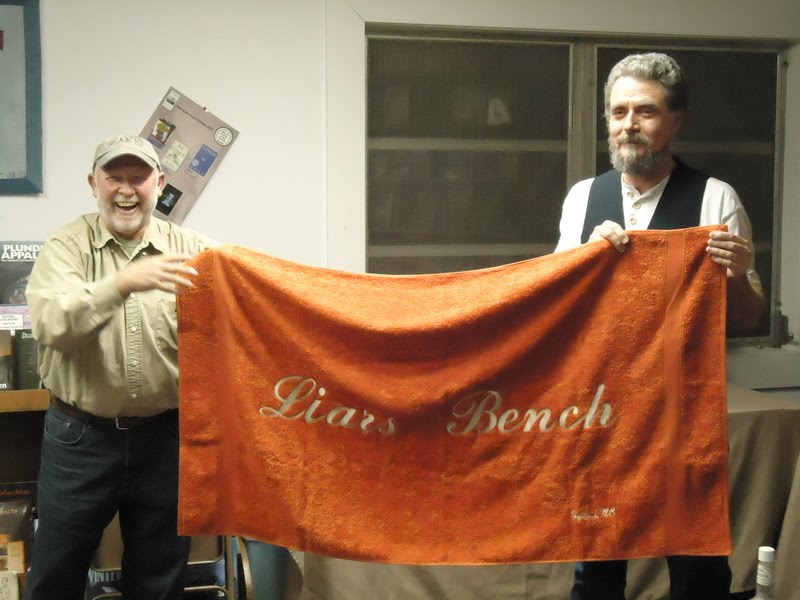
THE LIARS BENCH HOSTS BOOKSIGNING FOR STORYTELLER, SAUNDRA KELLEY - NOVEMBER 20, AT CITY LIGHTS
Labels:
Appalachian music,
Cherokee folklore,
outlaws,
storytelling
Friday, July 16, 2010
Saturday, March 27, 2010
AN INTERVIEW THAT GOT THE BIG ISSUES RIGHT!

This past week, the Smoky Mountain News did an interview with yours truly which I have decided to post here. This one has the normal number of inaccuracies. For example, the radio in my bedroom was not a "transister," nor did my father drive an oil truck. That was my grandfather. And it was my great-great grand father that was shot by Kirk's raiders in Macon County. However, I am still pleased by this interview. Despite getting the minor facts wrong, Giles Morris got the message right. Thank you, Giles.
Carden wrestles with storyteller legacy
By Giles Morris • Staff writer
There are two voices inside Sylva storyteller and playwright Gary Carden. One belongs to the mountain man of letters whom author Lee Smith coined “the Appalachian Garrison Keillor.” The other belongs to an orphaned child who clung to a pink transistor radio to make it through the lonely nights on Rhodes Cove.
“I was a damned lonely little kid, and I’d turn that radio on and it was like a bright night light,” Carden said, his voice turned sweet on the memories of his favorite ‘50s radio shows.
Carden is one of the most recognized literary voices in Western North Carolina largely because of his ability to communicate the authentic experiences and cadences of a mountain culture that is nearly vanished.
As an artist, the tension in Carden’s work is grounded in the double-consciousness of a man who knows firsthand the feeling of being “found wanting” and who still expresses pride in his heritage.
“I kind of turned into a missionary of some kind because I felt it was my job to communicate my culture,” Carden said. “Can you tell people about mountain dialect and the way my granddaddy lived without communicating ignorance?”
For Carden, the question is personal and not abstract. His father drove an oil truck and played in a mountain band until he was shot dead in his own garage by a loafer drunk on wood alcohol.
“It was an accident that didn’t make sense. That’s the kind that bothers you forever,” Carden said.
His mother, only 18 at the time of the killing, left him with his grandparents and went to Tennessee.
While his story is the type of Appalachian biography that reeks of authenticity, Carden reckons what makes him real isn’t his personal tragedy so much as the shared pain of growing up ashamed of his own voice.
“My granny warned me –– and most mountain people know this –– when I got out of college,” Carden said. “’Garneal,’ she said. ‘When you get out of here, you’ll be weighed and you’ll be found wanting.’ And she was right.”
Last weekend, Carden staged his play “Nance Dude” at Western Carolina University’s Coulter Auditorium to benefit the Friends of the Jackson County Main Library. It was the second performance of the two-part library benefit featuring actor Elizabeth Westall in two one-act plays that draw a line between history and folklore.
“It’s a special category. It’s history becoming folklore,” Carden said of “Nance Dude.” “There comes a time when people start decorating the facts and at some point the history becomes folklore.”
The play showcases two of Carden’s innate gifts: his ear for Appalachian dialect and his ability to normalize the brutality of dark mountain history with humor and humanity. “Nance Dude” re-tells the true story of a Haywood County woman convicted for the murder of her granddaughter.
Carden rem-embers his own grandmother explaining to him why his grandfather “didn’t laugh much.” She told the story of Kirk’s Raiders shooting down his great-grandfather in cold blood and leaving the body on the front porch.
“When my grandmother told me that story, she’d pull me right to her face and say ‘Don’t you forget what they did to Bryant,’” said Carden. “And of course I think that’s one of our greatest flaws as a culture ... the way we carry grudges.”
But “Nance Dude” also gets at the root of why Carden, now in his 70s, still burns hot in quest of his defining work. Carden has won awards as a writer and a storyteller, and honorary degrees as a folklorist, but he has never gotten the one acclaim that would put to rest the prophetic fear his grandmother instilled in him.
“My work has never been considered significant enough to be published,” Carden said.
Carden wonders whether his identity as a storyteller hasn’t limited him.
“Playwrights have a hard time. Poets have it harder. And storytellers have it the worst,” Carden said. “What do you do with a literate Appalachian storyteller? A mountain storyteller is supposed to be a hick with a wooly beard who’s never read a book.”
But Carden’s not making excuses. Instead, he’s still searching for his defining moment as an artist. He recently finished a play called “Signs and Wonders” that casts a light on the damage Pentecostal preachers from Bob Jones University did during their student auditions in mountain towns in the ‘50s. But he thinks there’s something bigger brewing in him.
“I’m kind of in stasis,” Carden said. “I need to do something significant. I’m bored and I’m not content with what I’ve done. I’ve got about 10 plays that need to get done and I know they won’t be.”
Some of Carden’s best written works are published in a collection called Mason Jars in the Flood & other stories. The autobiographical “Harley stories” are his version of Hemingway’s Nick Adams stories, autobiographical tales about growing up that carry both the personal and cultural angst of a moment in time.
Carden grew up in the mountains when the world was turning modern, and the mountain folk were being shut out of their own home. He became a man of letters, earning two degrees from Western Carolina University. When he writes about his childhood, he does it in clear and beautiful prose that hints at a fundamental conflict.
“You have to live in two worlds,” Carden said. “Culture demands it of you.”
Gary Carden, the artist, is still looking for the perfect way to call the world to account for the wrongs visited on Appalachian people since the Civil War and on his heart since his childhood. Like many writers, his thirst for success is fueled by a drive to hold life accountable for the pain it dispenses.
“My strength is the same as my grandparents’ inability to forgive,” Carden said. “I can’t forget things that are wrong. I want to see justice done.”
See “Nance Dude” this week
A DVD viewing of Gary Carden’s “Nance Dude,” performed by Elizabeth Westall, will be held 2 to 4 p.m. on Tuesday, March 30, at the Waynesville Library Auditorium. Carden will offer time for discussion and question & answer following the play.
Labels:
ancient tradition,
heritage,
playwriting,
storytelling
Wednesday, January 6, 2010
YOU WANNA HEAR A STORY?
P. S. In case you haven't noticed, he reviews books. Readers rarely comment on them because they are too long and often boring....but, hey, let's humor him. Read his review. He will fawn on you like a love-starved kitten.
Labels:
local fools,
oral tradition,
social outcasts,
storytelling
Saturday, September 12, 2009
TEACHING A MOCKINGBIRD TO SING

It is a sad thing that mockingbirds sing everybody’s song but their own.
- Old folk saying
In recent years, people frequently ask me if I think that “storytelling can be taught.” The question has been prompted by the fact that several academic institutions in this region are offering “degrees in storytelling.” The most notable example is the program at East Tennessee State University that has been endorsed by some folks at Jonesborough, our "Mecca of Appalachian Storytelling.” A quick Google survey indicates that the idea is beginning to spreading to other institutions that are currently offering storytelling degrees - recommended for “potential social workers, teachers and ministers.”
Since I am an elderly yarn spinner, I don’t feel especially threatened by programs that offer degrees and academic sanctions for a craft that I have always considered “a kind of inner compulsion” – something that I have always done because I felt compelled to do it. Admittedly, I did have a brief, fanciful vision in which I imagined a future time when grim-faced agents would arrive on my porch to serve me with a subpoena for practicing “without a license.” Also, I admit that I find a certain surreal distress in learning that storytellers, who have traditionally been “outside” conventional society, are now being told that they need “professional training.” We are being ushered "inside" provided we can meet the eligibility requirements.
I guess I am evading the question, so let me say that I do not feel that storytelling can be taught effectively unless the aspiring teller already possesses an innate talent. I think that the world is full of potential storytellers, but many lack the confidence to venture onto a stage without encouragement. If acquiring a degree from a college or university will instill that confidence, then perhaps
“professional training” will serve a purpose. For the would-be storyteller, it would be like “having his/her parking ticket validated.”
I am a bit cynical about the necessity of an academic program for storytelling since there is bountiful evidence that scholars sometimes dismantle and rearrange creative subjects (popular novels, film, storytelling), forcing them into patterns that have structure and references, but in the process, the scholars manage to remove some inner spark of spontaneity (they sap the natural energy) that made the subject vitally alive. I still remember when “oral history and traditional music studies” were often a breathtaking and vital experiences; however, that was before the field was “refined, structured” and filled with tape recorders and interviewers, each with a rigid format that intimidated both the audience and the performers.
But, let me get back to storytelling. In conjunction with Jonesborough’s emergence as the “capital of storytelling,” I began to encounter storytellers who ascribed to strict rules regarding “the way a story should be told.” Since I had never been officially accepted as a “teller” at the annual Tennessee festival, I was often “diplomatically instructed” by Jonesborough veterans: I should memorize my story and respect “time limits.” Further, I was advised to “never touch the microphone” (I rarely use one anyway) and “assume a proper posture.” There were topics I should avoid and others that I should strive to include in my tales (Storytelling should teach valuable lessons!).
Since I believe the essence of storytelling is spontaneity, I never memorize stories. From the time I was a child, I was aware that the telling of a story involves a mutual exchange between the teller and his audience. Something flows between a teller and a listener. I have always felt that audiences feed on a teller’s energy and a teller is "sustained by an audience’s approval/acceptance." I guess it is a kind of symbiosis. When I talk to my peers, they invariably express the same feeling – their awareness of the near-magical exchange between teller and listener.
Further, I am wary of storytellers who indulge in a kind of mindless repetition of old stories: Jack Tales and fairy tales. Indeed, some storytellers develop a menu of carefully memorized material that can be regurgitated on cue. That is not my idea of what storytelling should be. While I can admire the precision, clear enunciation and the precise movements and gestures, this is not my kind of craft. It does not make allowances for that sudden, inspired moment that only comes when both audience and performer are in harmony and exploring a facet of a tale that they have discovered together – the moment when the mockingbird sings its own song.
As a consequence, I am something of a maverick, and I strive to emulate other mavericks – Don Davis and Garrison Keillor, for example … Storytellers who search for that common experience which blends pathos and laughter. In the past 30 years, I have learned to draw my inspiration from a “personal folklore” in which I and my mortal and deeply flawed relatives, ancestors and peers behave foolishly, suffer profoundly and struggle for dignity – actions that strike a familiar chord in any audience.
The storytellers that I heard in my childhood didn’t appear on a stage with a microphone. They talked quietly to an intimate audience at funerals, Sunday services, weddings, graduations and family gatherings. They didn’t have big belt buckles, silly hats or colorful shirts, but they told anecdotes that reflected their culture and tradition with authenticity and integrity. Sometimes, they made me proud of who I am and where I live.
I don’t think you can teach that in a storytelling course.
Thursday, July 23, 2009
ODE TO MY COUNTY
Although I sometimes wish that the maps of my county had a more beguiling shape -perhaps a bear or a quarter moon - its outline is pretty prosaic (it resembles a porkchop; but marvelous events, mythical and real, noble lives and tragic encounters have occurred within these boundaries. Let's begin with the fantastic.
According to the Cherokees, the witch, Spearfinger once lived on Whiteside mountain where she often stood at night on the high cliffs during raging thunderstorms, brandishing her deadly digit and laughing. The great serpent, Uktena once swam in the Tuckasegee (the marks of his scales are still etched in the river’s rocks). The giant, Judaculla, the “Slant-eyed One,” now sleeps in the Balsams, his flinty, upturned features visible at Pinnacle Rock. A hundred coves and creeks whisper of vanquished water spirits, nunnehi, “little people,” raven-mockers and giant eagles.
Then, there are the “maybe, maybe nots” – Jackson County tales of people, creatures, events and places that live in the twilight realm between reality and myth: a pregnant Nancy Hanks biding farewell to the Enloe farm (somewhere in Jackson/Swain)as she rides away with Tom Lincoln; The ghostly baying of Boney (sometimes called Bonas), the legendary hunting dog that leaped to his death from a cliff near Cashiers; the Tuckasegee “Smoke-hole” that was rumored to have great curative powers – now vanished; the chilling scream of “painters” in Little Canada (They were drawn to houses with new-born babies and lactating mothers.)
Many famous and infamous folks have lived here briefly and then traveled on to other destinies. William Bartram, whom the Cherokees called “flower plucker,” picked strawberries here; the outlaw, Major Lewis Redmond lived for several years at the King Place above Fisher Creek;
Will Holland Thomas built a home near Whittier and, according to oral tradition, buried gold in his pasture; Dr. John R. Brinkley, the “goat-gland-man,” who sold patent medicine on XERA and ran for governor of Kansas, built a summer home above Cullowhee (his name is still inscribed in the rock walls near the road); Charlie Wright, the man who rescued Gus Baty (who fell/jumped) off Whiteside (a feat that earned Charlie a Carnegie medal) was equally famous as the man who courted Kidder Cole, the most beautiful woman in Cashiers Valley - which brings us to Judge Felix Alley, another Jackson County native who not only wrote, Random Thoughts of a Mountaineer but also courted Kidder and when Wright “beat his time,” he wrote a famous square dance piece, “The Ballad of Kidder Cole.” (The lyrics include the line, “Charlie Wright, dang your soul/You done stole my Kidder Cole.”) Kidder later married “Little Doc” Nickols in Sylva.)
Any county history that is not seasoned with a bit of local bloodshed and courtroom drama is likely to be a bland chronicle. My county has a generous helping. In my childhood, I often saw the infamous Nance Dude, trudging the roads near Wilmot with bundles of split kindling on her back; Bayless Henderson, the luckless killer of Nimrod Jarrett was hanged in Webster (2,000 witnesses, four preachers and picnic baskets.) There were mysteries, too. What happed to Frank Allison, the deputy sheriff who joined a foxhunt into the Balsams and never came home. There was also a minister in Glenville who went out one evening to call his cow home – his remains found over 40 years later and his identity verified by his gold watch.
Now, comes a few of our notable people and places. Gertrude Dills McKee, the first female senator for the state of North Carolina, read poetry by candlelight at the Jarrett House when she was a child and grew up to pass legislation that revolutionized education in this state. Robert Lee Madison, who grew up in the home of Robert E. Lee (and once told my 5th grade class about attending Traveler’s midnight funeral); attended (and described) the hanging of Jack Lambert (who was innocent), and founded a little college in Cullowhee that became Western Carolina University. The writer, John Parris, who launched a career when he interviewed a snake-bitten preacher named Albert Teaster and went on to write a series of books about the history and folklore of this region.
Is that all? In actual fact, these people, places and events are but the thin outer shell of my county. Beneath that resides my personal memories and dreams fostered by the Ritz Theater on Saturday; the courtroom of the Jackson County Courthouse where I sat in the balcony with my classmates and watched murder trials as gripping as anything that I witnessed at the Ritz; the music of Harry Cagle and Aunt Samantha Bumgarner; a little lady named Sadie Luck, Sylva’s first librarian who used to say, when I entered, “Gary, I’ve been saving a book for you;” and, finally, the faint echoes of a tannery whistle and (faintly) a song my father played long ago in the Rhodes Cove twilight, “The Raindrop Waltz.”
I think, perhaps the story of my county is just beginning. This is but a small, modest swatch in the gigantic tapestry (or perhaps a few bars of a symphonic musical score that is still being woven/written by countless fingers and voices. Can you hear it? I hear it best at night when I take out my cochlear implant and listen to the rich, dark silence and the unheard sounds around me.
Labels:
folklore,
history/tradition,
legend,
myth,
storytelling
Tuesday, May 26, 2009
THE MARTIN LIPSCOMB PERFORMING ARTS CENTER
May the God of Elderly Storytellers bless me and lower my blood sugar.
The nice lady that comes in every Monday and vacuums my house and picks up all the things that I have dropped during the past week (change, pens, books, etc) found a dead rat under my TV chair. I guess my semi-feral kittie, Booger, did that. It has been there for three or four days and really affected the atmosphere of several movies. I kept thinking it was my moldy old house, or my damp socks from spending the day outside in the rain, but, no, it was "a factor beyond my control." The nice lady (her name is Barbara) took the rat away and doused the room with Febreze. Last night, I watched Harlan Ellison ("Dreams With Sharp Teeth") rant and rage against the world (I love this guy), all to the cloying scent of honeysuckle and orange blossoms.
Wednesday, March 11, 2009
Preaching to the Chickens
When I was a little kid, I used to sneak into the local "fire and brimstone" church on summer nights and listen to the minister describe the torments of hell. I was aware that he was scaring some of the congregation, and I yearned to be able to do that ... make people hang on every word. After practicing a bit in front of the mirror in my bedroom, I started going to the chicken house at night. I would take a lantern and a Bible and I badly frightened those chickens! When I told them about Chicken Hell, they would get hysterical. I think my nightly sermons were good training for both teaching and storytelling. When I began painting, this was one of my favorite subjects. I've painted this one many times. Each time, I add a few more chickens.
Labels:
chickens,
hell and brimstone,
ministers,
storytelling
Monday, February 16, 2009
The Trials of Bodine
THE TRIALS OF BOUDINE
Several years ago, a merchant who operated a kind of novelty store in Bryson City, offered to trade some of his unique merchandise for some of my storytelling tapes. Specifically, he offered me a multi-colored, stuffed German shepherd. I was charmed by the big dog who sat in a corner staring benevolently at the world – he was life-size, chubby and had a quizzical expression that suggested that he had just seen something both puzzling and comical. We made the trade and I hauled my new pet (I had named him Bodine on sight) back to my car where I finally managed (by turning him upside down) to cram him into the back seat.
Jack, my Jack Russell, who was asleep in the front seat, awoke to discover that the car had been invaded. Snarling and barking, he climbed into the back seat, and bit Bodine several times, tearing hunks of cotton stuffing from his hindquarters. I managed to haul Jack back to the
front, but on the journey home, he sat backwards, snarling and snapping at Bodine’s defenseless rear.
At home, I placed Bodine on my front porch where he has remained for the past three years. Jack remained suspicious for a while, but finally befriended “Bodie.” From a distance, this fat shepherd appears to be a vigilant watchdog – a faithful servant devoted to protecting my humble abode. Visitors sometimes approach my front porch timidly, staring at the big mutt’s benign countenance a little nervously until they realize that “Bodie” is both harmless and lifeless. Eventually, Jack began sleeping between Bodie’s front legs, rising only to challenge the passing menace of cars, joggers, visitors and other dogs.
However, the years have not been kind to Bodie. The rains and snows of three winters have bleached his vivid coat: his black spots has become a kind of electric blue, his whites, a dingy grey and his browns are tinged with a pinkish yellow. Yet, he still stares doggedly (Forgive me, but I couldn’t resist that!) out at Cherry Street. A few times, strong winds have swept him off the porch and left him under nearby boxwood. I always retrieve him, brush down his matted coat, clean the spiders out of his ragged ears and return him to his post where he continues to regard Cherry Street with wry amusement.
Now, in view of Bodine’s character, you can imagine my surprise when I learned that he had been accused of murder and mayhem. According to recent reports, Bodine has been seen where he shouldn’t/ couldn’t be. Eyewitnesses have given graphic accounts of a “killer dog” who resembles Bodie, and he isstalking the dark woods of Painter Knob … a slathering beast with demonic eyes who preys on hapless victims: cats, chickens and other dogs.
According to one informed source that has seen the killer dog departing the scene of carnage, “It was a big
German shepherd.” Several days later, this witness happened to drive down Cherry Street and as she passed my house, she saw him. The killer! “There he sat on the porch of that old farm house – the very beast!” The eyewitness returned home and reported her discovery.
There was a general consensus that the concerned citizens needed to talk to the owner of this ravening beast. Me. Returning to Cherry Street, they drove slowly past. Yes, he was still there! They compared notes and discussed the best strategy.
Of course, someone finally mentioned that something wasn’t “quite right” about Bodie. One of the survalence crew finally said, “Has anyone noticed that … he never moves? He is always in the same spot and there is something “wrong” with his face…
When I became aware of the details of this strange story, I decided that my neighbors’ suspicions were well-founded. I have been unwittingly harboring a killer.
Although some of Bodie’s accusers are beginning to have doubts, I can only say this: “Don’t let that innocent act fool you. I think you have got the killer, dead to rights.”
Although the cars have stopped driving slowly by my house, I am eager to see justice done, but I’m not sure how to proceed. Should I take Bodine to the dog pound? Perhaps, we could do a lethal injection at one of the local vets? Whatever his victims decide, I would like to claim
Bodine’s remains. I think it is only fitting that even though he is a convicted felon, I feel that his remains can be rehabilitated. I would like to return him to his post on my porch. I would feel a lot safer knowing that he is watching the traffic on Cherry Street.
Saturday, February 7, 2009
Subscribe to:
Posts (Atom)
.jpeg)